How Place Shapes a Textile Tradition
Learn to read a cloth through the materials, weather, work, and local habits around it, without treating place as a single explanation for every detail.
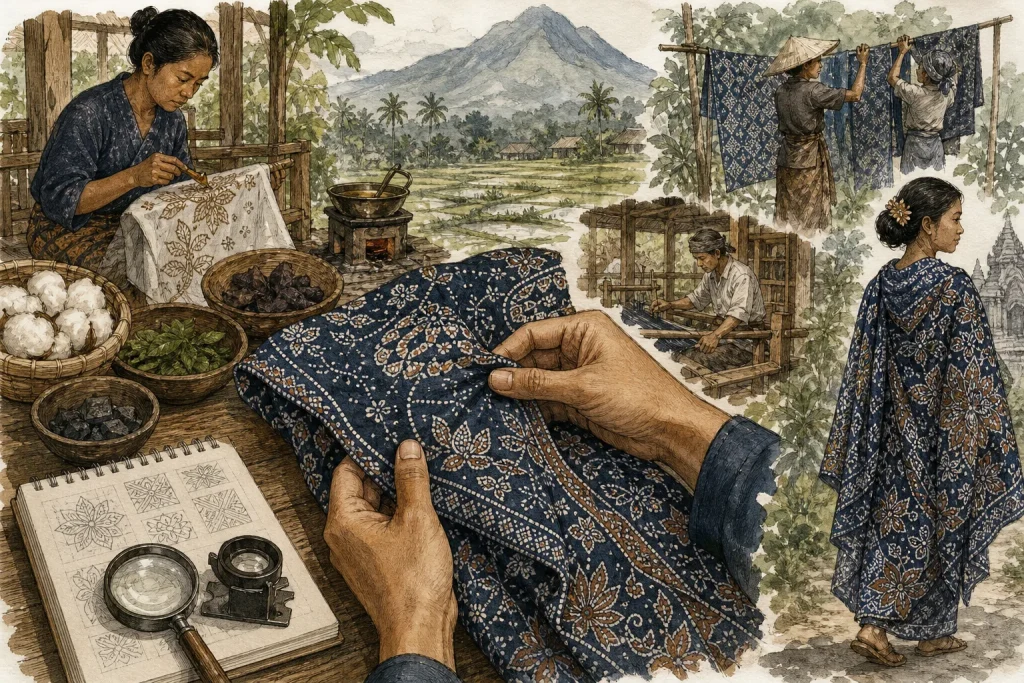
Learn to read a cloth through the materials, weather, work, and local habits around it, without treating place as a single explanation for every detail.
Places · 7 min read
Set a length of cloth beside its place of origin and small clues begin to matter: the weight of the weave, the feel of the surface, the way its colors sit together. A textile is not simply a design carried from one generation to the next. It is also the result of what people could obtain, how they worked, what the weather demanded, and how the cloth moved through everyday life. You can explore those connections without claiming that one landscape explains everything.
The guide below offers an orderly way to look. Start with the cloth itself, then consider materials, climate, making practices, and use. Treat each connection as a question to investigate rather than a rule. Textile traditions change, and makers make choices that are personal, commercial, devotional, or practical as well as local.
Begin with the cloth in front of you
Choose a textile you can examine directly, such as a scarf, a market-bought length of batik, or a fabric in a museum display. If it is not yours, follow the institution’s handling rules; do not touch a fragile or displayed piece without permission. Note what you can actually observe before reaching for explanations.
- Look at the fiber or surface information on a label, if available. If there is no label, describe the feel and appearance without guessing the fiber.
- Notice whether the cloth is thin, dense, crisp, soft, smooth, or textured.
- Look closely at the weave, seams, edges, and any signs of handwork or machine finishing.
- Observe the colors and pattern placement, but do not assume a motif has a particular meaning from appearance alone.
- Record the object’s stated place and date, if known, and distinguish that information from your own observations.
This first pass gives you a grounded starting point. “The cloth feels light and has a tightly arranged pattern” is an observation. “It was made for hot weather” is an interpretation that needs more context.
Ask what materials were available
Next, consider the fibers and colorants that makers could access, but keep the difference between possibility and proof in view. Cotton, silk, wool, flax, and other fibers each have their own feel and behavior. Their availability can depend on local growing conditions, trade, household economies, and changing markets. A cloth’s place of production does not automatically tell you where its raw materials came from.
Look for trustworthy object information: a maker’s description, a museum catalogue, a cooperative’s material notes, or a knowledgeable seller who can explain the textile’s origin. Ask whether the information refers to the fiber source, the dyeing location, the weaving location, or the place where the cloth was sold. These may be different places.
For color, consider the making method before assigning a source. A dyed textile may use plant-based, mineral, or synthetic colorants, and appearance alone rarely identifies them reliably. In batik, wax-resist work shapes where dye can reach the cloth, but the resist process does not by itself establish which dyes were used or where they came from. If the colorant matters to your understanding or care of the piece, seek documentation rather than relying on a visual guess.
Consider how climate may affect cloth
Climate can influence what people value in fabric. In warm, humid conditions, a maker or wearer may favor a cloth that feels airy and drapes easily; in cooler conditions, a denser weave or layered garment may be useful. But this is a broad possibility, not a formula. Indoor work, ceremonial dress, fashion, and trade can all shape a textile independently of the weather.
Ask practical questions: Is the cloth made to be worn close to the body, layered, wrapped, or used in a home? Does it appear designed to move easily, hold a structured shape, or cover a surface? Are there local garment forms or household customs that help explain its use? A textile may serve different purposes in different settings, even within the same region.
Be cautious about reading wear as climate evidence. Fading, softness, or abrasion can result from age, washing, storage, or frequent use. A cool, shaded museum display may also make a fabric look different from how it once appeared in daylight. Describe what you see, then look for context.
Look at local practices and working conditions
Textile traditions are carried by people, tools, and shared knowledge. The relevant practices might include preparing fiber, spinning, weaving, printing, resist dyeing, sewing, or finishing. Some work happens at home; some belongs to workshops, cooperatives, or factories. Local resources matter, but so do skill, access to tools, family teaching, and the demands of buyers.
When reading about a tradition, look for accounts that name makers and explain their process in their own terms. Notice whether the description distinguishes community practice from an individual artist’s choices. Avoid treating a whole region as if every maker follows the same method. Techniques can vary by village, workshop, generation, and intended market.
Tools offer useful clues when they are documented. A loom, carving tool, printing block, or wax applicator can indicate how a surface was made, but not necessarily who made it or what it meant to the maker. Seek a source that connects the object to its production rather than filling gaps with assumptions.
Trace how the cloth is used
Now ask what the textile does after it leaves the workshop. It may become clothing, a wrap, a ceremonial object, a household furnishing, or a material for another craft. A cloth’s dimensions, finish, and construction can offer hints, but intended use is best confirmed through local knowledge and reliable documentation.
Pay attention to how people wear, fold, tie, or display it. These actions are part of textile knowledge, not merely decoration. If a particular way of wearing the cloth is associated with an event or community, seek an explanation from a relevant cultural source rather than presenting the practice as universal.
Use can also change over time. A fabric once made for everyday wear may later be collected, framed, or sold to visitors. That shift can affect which patterns are produced and how makers describe them. A careful account leaves room for both continuity and change.
Keep observations separate from conclusions
Before writing a description or making a purchase decision, sort your notes into three groups: what you saw, what a source confirmed, and what remains a question. This simple method makes your account more useful and respectful. It also helps you avoid turning a plausible connection into a claimed fact.
- Observed: record visible qualities such as texture, weave, color arrangement, and finishing.
- Documented: note information supported by a label, maker, museum, or other identifiable source.
- Unconfirmed: list ideas about fiber origin, dye, intended use, or symbolism that need better evidence.
- Next action: ask a specific question, consult a reliable catalogue, or leave the point open if no answer is available.
Hypothetical worked example: reading a lightweight wrap
Starting situation: Imagine you are examining a lightweight patterned wrap at a craft exhibition. Its label says it was made in a coastal town, but gives no fiber or dye information. You can see a soft drape, a narrow finished edge, and a repeated design.
Actions: First, write down those visible details without assigning a use. Then ask the exhibition staff whether the maker or catalogue identifies the fiber, production method, and intended use. Suppose the catalogue confirms that the wrap was woven locally but does not identify where the fiber was grown or how the colors were produced. Keep those origins marked as unknown. Finally, look for a maker’s description of how the wrap is worn, rather than inferring that from its lightness alone.
Expected result and tradeoff: You can describe the object as a locally woven, lightweight wrap with documented production details, while leaving its fiber source, colorants, and precise climate-related purpose unresolved. The account will be less dramatic than a confident story about local plants and sea air, but it will be more accurate and leave room for the maker’s own explanation.
Carry the context into your next encounter
When you meet a textile in a shop, collection, or home, begin with what is visible and ask which parts of its story are documented. Follow materials, climate, practices, and use as connected questions, not as a chain of automatic causes. If you are buying a piece, a clear answer about who made it and where the work took place is often more useful than a broad claim that it is “traditional.”
Keep your notes with the object’s label or source information. Later, a maker’s account may clarify an uncertain detail or complicate an assumption. That is not a failure of interpretation; it is part of learning to see a textile as the work of people in a particular place, rather than as a pattern detached from their lives.
Related reading
Storing Folded Fabric to Reduce Wear
A shelf, drawer, or storage box can each suit folded fabric. Choose by checking the textile,…
Building an Outfit Around a Patterned Textile
A prominent textile can lead an outfit without overwhelming it. Learn how to balance pattern scale,…